Remember that scene in The Flash where everything moves at lightning speed? That is precisely what consumers expect these days: not tomorrow, not in an hour, but immediately.
Jeff Bezos once commented, “We’re not competitor-obsessed; we’re customer-obsessed.” And the truth is for the customers nowadays, speed is their obsession in quick commerce apps india.
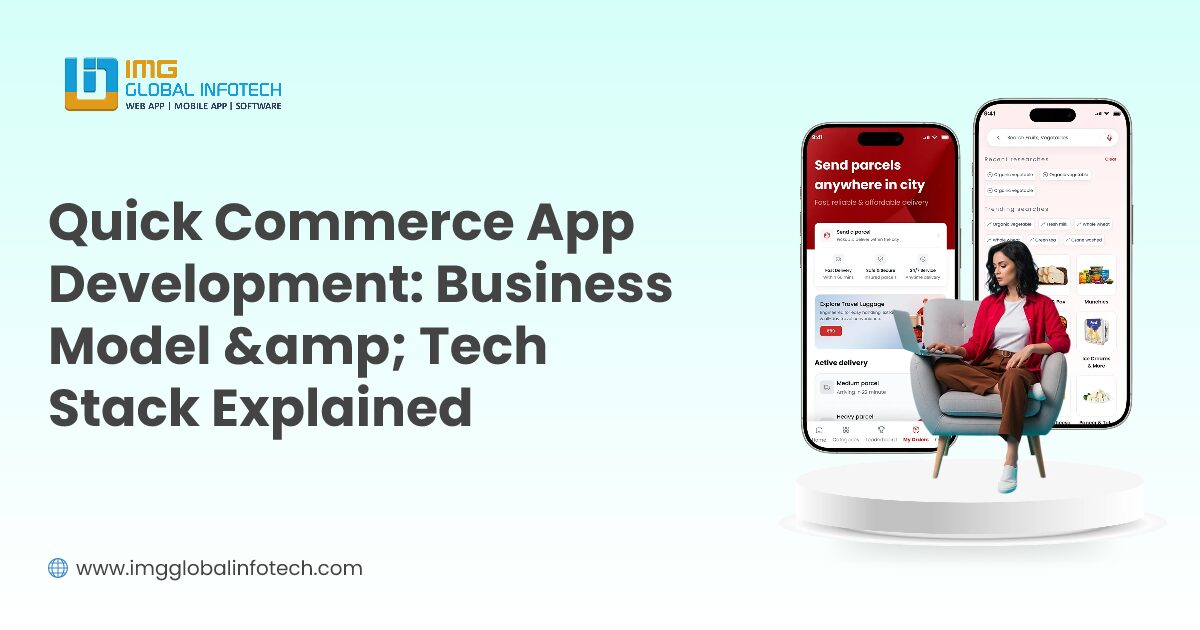
Quick Commerce or Q-commerce is the evolution of e-commerce that uses the hyper-local delivery model, aimed at delivering micro-orders in less than 10 to 30 minutes.
Traditional e-commerce networks are dependent on the use of large, centralized regional warehouses, while a Q-commerce infrastructure would utilize a network of decentralized dark stores (micro-fulfillment centers) distributed within high-density urban areas.
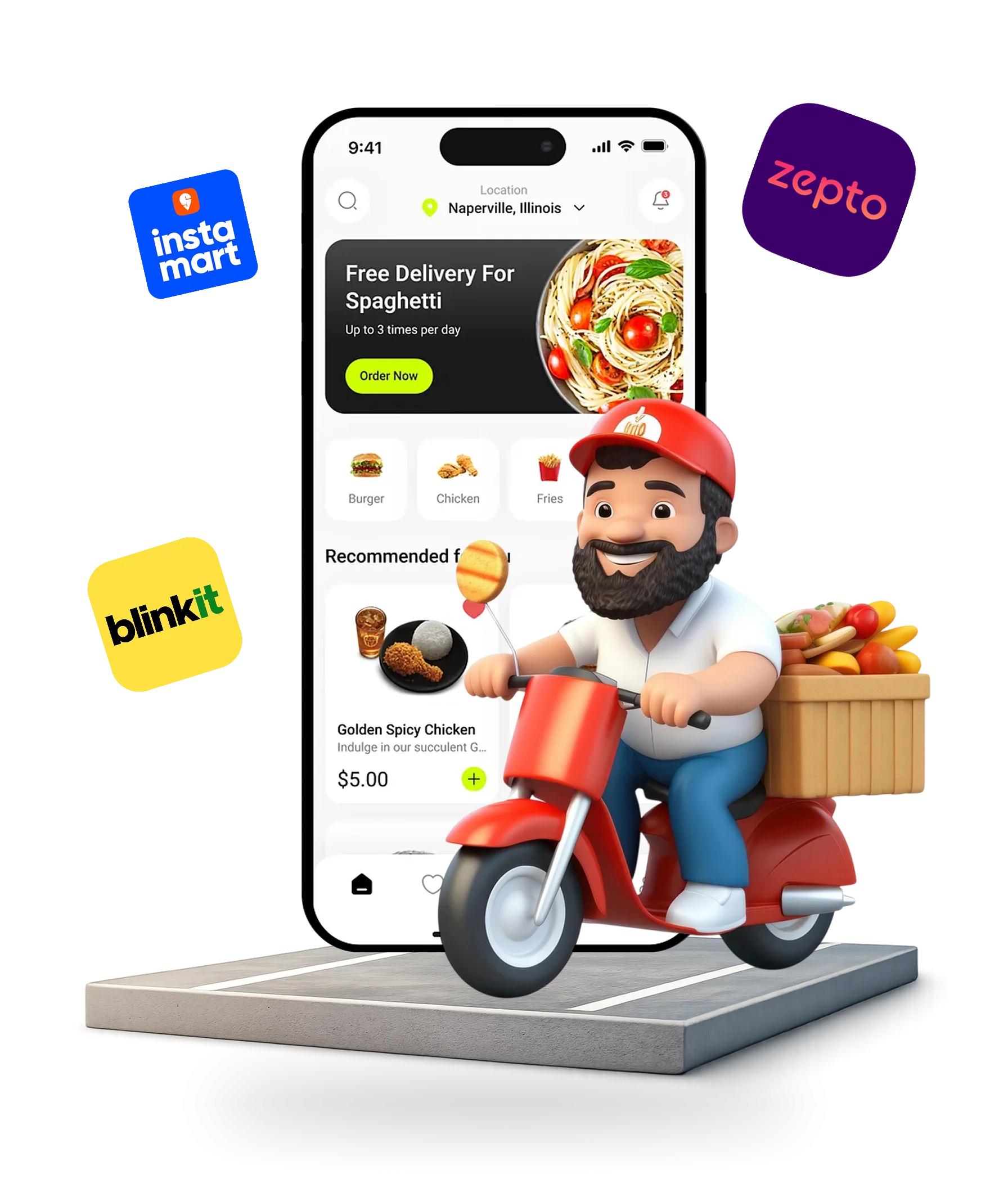
Blinkit, Zepto, Swiggy, Instamart—these are not merely e-Commerce apps;these are infrastructure revolutions cleverly disguised as a UI. Think of it as Mission Impossible: every second matters, and each node in the system must carry out its task flawlessly, or the entire operation will fail.
Making one? It is risky, difficult, and very exciting at the same time. This book is a comprehensive list of architectural, logistical, and technological considerations to be made at each stage of the product lifecycle from conception to deployment.
Get ready. The clock is running.
What Is a Quick Commerce App?
Quick commerce, often abbreviated as Q-commerce, is a model where consumers place orders for indispensable products and get them delivered in a very short time frame, typically 10-30 minutes in quick commerce app development.
These products are generally everyday essentials like food, snacks, personal care items, medicines, pet supplies, and so on in quick commerce apps. The intention here is to meet needs on the spur of the moment or those revealed by immediate cravings or emergencies with medicines. It depends on:
How Do Quick Commerce Apps Work?
Quick commerce apps can deliver products within minutes through inventories and warehouses. These store places have a wide range of popular products across diverse categories that include groceries, cosmetics, electronics, and many more in quick commerce apps in india. These apps are also majorly based on locations for faster deliveries in business as well.
Here is a stepwise pattern that reflects how quick commerce applications handle operations:
- Customer Order: Customers search and place orders through the applications.
- Order Conquest: The requirements are majorly sent to the nearest warehouses.
- Store Gratification: The warehouse manager can handle packaging and handover process
- Last-Mile Delivery: A delivery partner can bring the order to the doorstep
- Inventory Provision: AI-driven systems have to update stock in inventories.
What are the Key Features of a Quick Commerce App?
Quick commerce applications transform shopping behavior by providing instant access to essential items, which they deliver within minutes in On-demand app development services. The six main elements establish the essential characteristics that enable a q-commerce platform to achieve market success.
- Real-Time Live Tracking Engine: Basically, it keeps persistent network connections plus the GPS location services active, then it pushes delivery coordinates out smoothly, so the customer stays in the loop and also fewer support questions pop up
- NLP-Powered Smart Search: It leans on Natural Language Processing (NLP) and predictive text, to show matching in-stock products in a split second, like right after you tap the keys
- Hyper-Local Geofencing Module: This dynamically limits product availability based on the live inventory status coming from the nearest operational micro-warehouse, kind of like a tight perimeter around what’s actually possible
- One-Tap Frictionless Checkout: It reuses pre-authorized tokens and geolocated address profiles, so checkout feels faster, and cart abandonment doesn’t really happen as much, or at all
- Dynamic Algorithmic Pricing Engine: It recalculates prices and what promotions are currently active in real time, based on peak order demand, weather patterns, and localized supply levels too
- Automated Inventory Intelligence: It syncs dark store shelf updates with the customer app interface almost instantly, so users don’t end up buying stuff that’s out of stock later.
.
Step-by-Step Process to Build a Quick Commerce App
There are a number of important steps to take when making a quick commerce app. Each step makes sure that the app is useful, easy to use, and will do well in the market in quick commerce mobile app development.
Market Mapping & Inventory Planning
Do hyper-local demographic research, really to figure out product demand patterns. Define your main target group, delivery radiuses, and first inventory buckets while you also compile a full suite of software requirements.
High-Velocity UI/UX Design
Go with a “time to checkout” mindset. Cut down the tap routes, build crisp search bars, and design a native layout architecture that supports rapid movement for customers and for the active delivery couriers, too.
MVP Architecture Development
Create a Minimum Viable Product (MVP) that focuses on the core stuff: real-time cart operations, geofenced tracking, and basic rider notifications. This step sets up the real codebase base while avoiding early spending that feels wasted.
Concurrency Testing & Performance Optimization
Put the platform through heavy load testing so you can see how the backend reacts during sudden order surges. Then do multi-device optimization to remove system glitches, app crashes, and those annoying latency issues before you publish.
Deployment & Strategic Branding
Roll out your client applications in the Apple App Store and Google Play Store. Time the technical launch with hyper-local digital advertising pushes so early user acquisition ramps up in the areas you already serve.
Continuous Feature Iteration
Ship steady application updates based on live user feedback analytics. Keep improving the matching algorithms, patch the database security barriers, and scale system capacity as your dark store network gets bigger and more distributed.
How Much Does it Cost to Build a Quick Commerce App?
The average cost to build a quick commerce app would be $5,000 to $15,000 or more. The exact cost mainly depends on diverse factors and the level of the customization in the app development process as well.
What are the Best Monetization Strategies for Instant Delivery Apps?
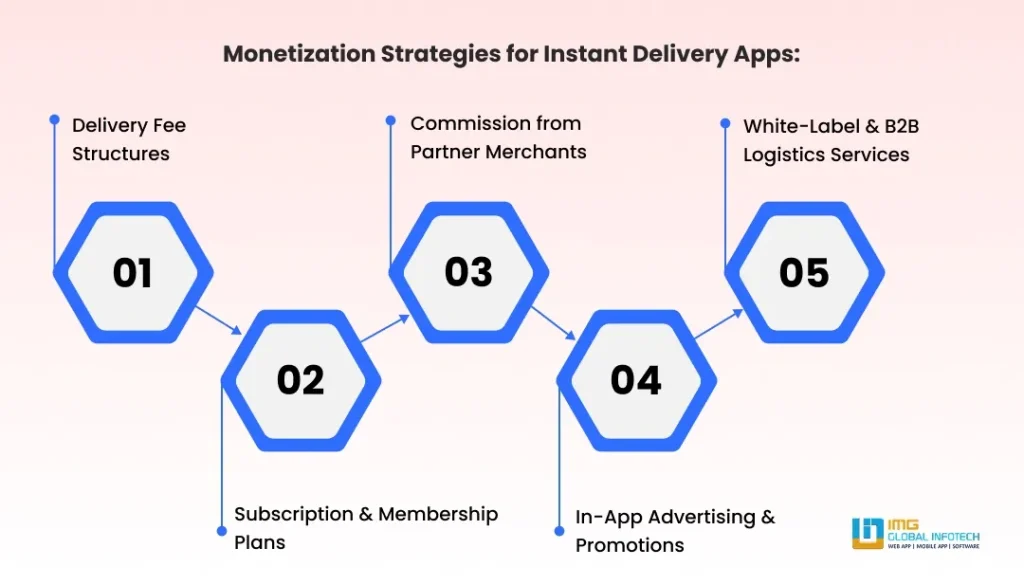
People can now get products through instant delivery applications, which create modern shopping methods that provide customers with exceptional access to products to start a quick commerce business.
The platforms need to develop various new methods for making money to support their business operations while achieving financial growth.
Delivery Fee Structures
The most straightforward method of generating revenue for apps involves charging users delivery fees, which depend on either their order volume or the distance they need to deliver.
This method enables apps to pay for delivery expenses while using surge pricing during their busiest operating periods.
Subscription & Membership Plans
The company establishes premium membership plans that provide users with free deliveries and exclusive discounts and faster service to Build a quick commerce app for startup.
This approach drives customer business and creates dependable income streams. It also boosts the total value of each customer relationship.
Commission from Partner Merchants
The delivery service collects a commission from every order that customers place through its application.
This payment system encourages merchants to show their products on the platform because it gives the service provider a way to make money based on customer purchases.
In-App Advertising & Promotions
The application generates substantial advertising revenue through paid sponsorships and special display space and audience-targeted advertisement banners.
This revenue stream automatically expands together with the platform’s growing number of active users.
White-Label & B2B Logistics Services
The application creates two business paths through its delivery ecosystem. The first route involves providing white-label delivery solutions to retailers.
The second route establishes B2B logistics alliances. Both routes enable the application to access high-value enterprise contracts. These contracts create additional recurring revenue streams.
Why Choose IMG Global Infotech for Quick Commerce App Development?
If you are looking for developing powerful and scalable quick commerce applications, look no further than IMG Global Infotech. We are a reliable technology partner who can help you build apps that are not only powerful but also scalable, ensuring efficiency, speed, and business growth.
Proven Quick Commerce Expertise
Our team consists of highly skilled professionals who have extensive experience in developing feature-rich quick commerce applications. We understand the demands of the quick commerce industry quite well and can develop apps that ensure fast delivery, efficiency, and a great user experience for both users and businesses.
Custom-Built App Solutions
Our developers do not believe in delivering off-the-shelf or standard app solutions. They understand the need for custom-built apps and carefully analyze your business requirements before developing feature-rich quick commerce apps to Build instant delivery app like zepto. We ensure that all apps we develop are custom-built, matching your business needs perfectly, and are a true reflection of your business identity.
Advanced Technology Stack
Our team of developers is committed to using the latest technologies, tools, and frameworks for developing feature-rich quick commerce apps. We understand the need for using modern technologies, tools, and frameworks for developing powerful and scalable quick commerce apps, ensuring efficiency, speed, and business growth.
End-to-End Support
We offer end-to-end services starting from ideation and designing to development and deployment. Our experts will ensure that your quick commerce app works smoothly throughout these phases in Grocery delivery app development. We also offer dedicated post-launch support to address any issues and ensure that your quick commerce app works to the best of its capabilities.
Agile & Faster Delivery
Our team of experts follows an agile development process to ensure that your quick commerce app is developed and launched faster without compromising on quality. We divide our tasks into efficient sprints to ensure timely updates and a quick commerce app developed and launched before our competitors.
Scalable & Secure Architecture
Our team of experts develops quick commerce apps with a scalable architecture to grow along with your business. We implement industry-standard security protocols to ensure that user information is protected and there is no disruption in app performance due to increased user traffic.
Final Verdict
The blog guide provides you with information about Quick Commerce which demonstrates its rapid development because it meets urgent customer needs for product delivery in the e-commerce market by our leading Instant delivery app development company. The statement that Quick Commerce will become the future of e-commerce needs no correction.
The main reason to implement Quick Commerce into your e-commerce business through a top mobile app development company exists because businesses need to adapt to changing market conditions. The professionals possess superior expertise to identify which locations need quick commerce services the most.