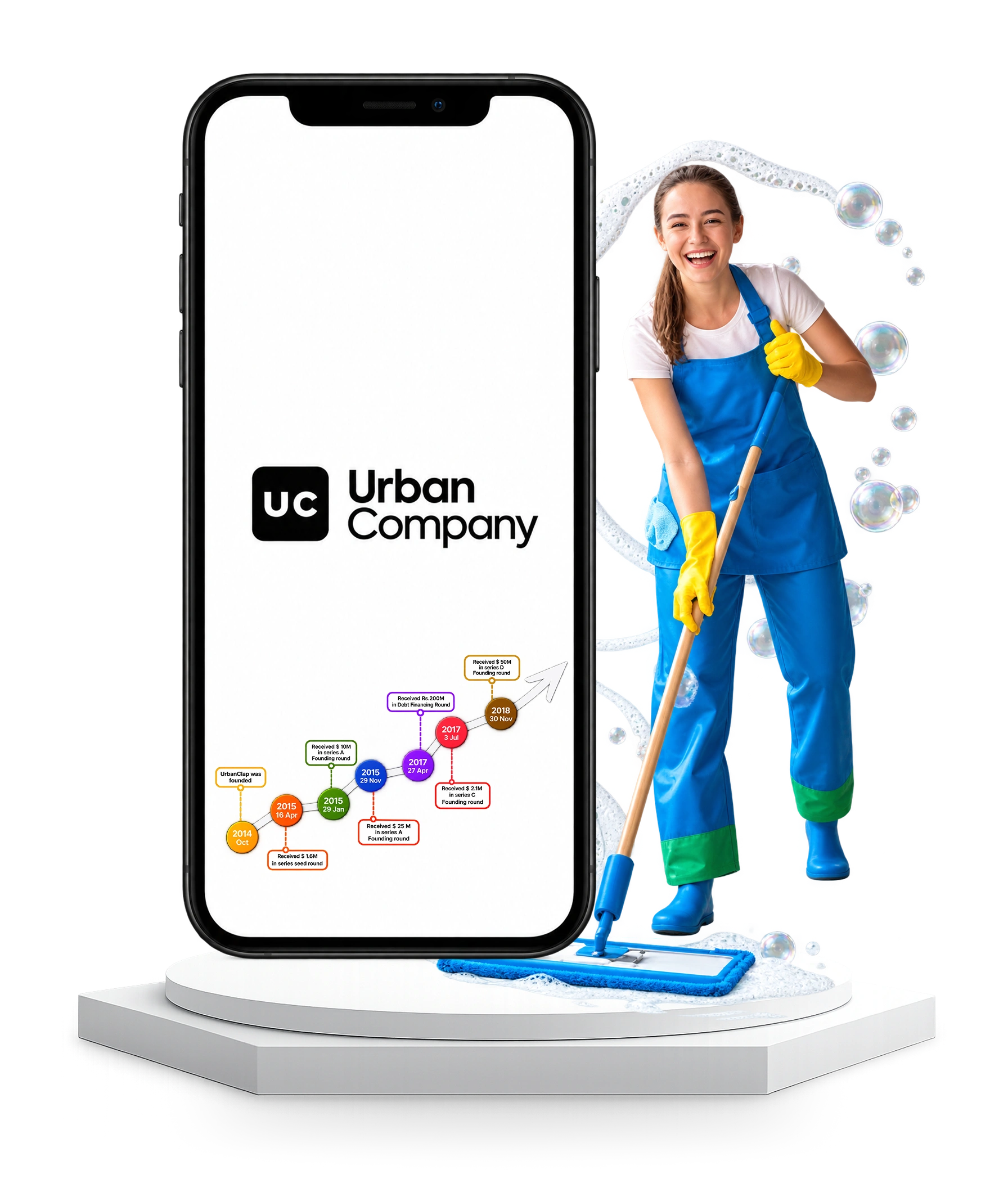
Urban Company (the rebrand of UrbanClap) is the go-to reference whenever a founder pitches an “on-demand app for X.” It looks simple from the customer side: open the app, pick a service, a vetted professional shows up at your door. Underneath is a managed marketplace with a genuinely hard operational core — matching supply to demand, guaranteeing quality from people the platform doesn’t employ, and collecting money cleanly on both sides. This guide breaks down how the Urban Company business model actually makes money, the parts that are painful to run, and what it takes to build a home-services app that works like it.
How the Urban Company marketplace works
Urban Company sits between two groups and takes responsibility for the experience between them:
- Customers who want a specific service at a specific time — salon at home, appliance repair, deep cleaning, plumbing, painting — at a predictable price, without haggling or chasing an unknown handyman.
- Service professionals — individuals and small crews — who get demand routed to them instead of hunting for it, plus tools, training, and a payment rail.
The important nuance: this is not a pure listing marketplace like a classifieds site, where the platform just introduces two parties and steps back. Urban Company runs a managed marketplace. It sets or heavily influences the price, standardizes the service (what a “deep clean” includes, which products get used), trains and certifies pros, and owns the ratings and refunds. That trust-and-quality layer is the actual product. Customers aren’t paying for access to a plumber; they’re paying for the platform’s promise that the plumber will be vetted, on time, and accountable.
That single decision — owning quality rather than just brokering contacts — is what makes the model defensible and also what makes it expensive to operate. Every design choice downstream flows from it.
Where Urban Company makes money
A marketplace this size doesn’t rely on one revenue line. The Urban Company revenue model layers several, and understanding them is essential before you copy it.
Commission on each booking
The primary stream. When a customer pays for a completed service, the platform keeps a percentage and passes the rest to the professional. This is attractive because revenue scales directly with transaction volume — no service is delivered without the platform earning. It’s also the most contested part of the model: professionals have publicly pushed back on commission levels and added fees, which is a real, recurring tension in any two-sided marketplace. If you build one, your commission rate is not just a pricing number; it’s the lever that decides whether supply stays or leaves.
Subscriptions and lead access for professionals
Beyond per-job commission, platforms monetize the supply side directly — membership or activation fees, “lead” or connection credits that let a pro receive more job requests, and paid tiers that improve visibility. This shifts some revenue from being purely outcome-based to being access-based, which smooths income but has to be balanced carefully so pros feel they’re getting value, not being taxed twice.
In-app product and consumable sales
Because Urban Company standardizes how a service is done, it can supply the products used to do it — cleaning solutions, salon consumables, spare parts, tools. Selling these to professionals (and sometimes recommending products to customers) adds a retail margin on top of the service commission and reinforces quality control at the same time.
Convenience and ancillary charges
Visitation or booking fees, cancellation charges, and dynamic pricing during peak demand are smaller lines that also shape behavior — discouraging no-shows and smoothing demand across the day. Some platforms layer in financing or insurance for pros as further monetization. None of these are the headline number, but together they widen the margin on a business where the core commission is under constant pressure.
The operational hard parts nobody sees
The app is the easy 30{dc0ffc4ab34e16dede428d6f7e87e16b028650deee990f9dd36aa043571e749d}. The reason most “Urban Company clones” stall is the operations underneath, which no amount of clean UI fixes.
- Supply is the real bottleneck. A services marketplace is only as good as the professionals available in a given pin code at a given hour. You have to recruit, verify (ID, background, skill), train, and — critically — retain pros, all before you have enough customer demand to keep them busy. Launching city by city, category by category, is a supply problem far more than a software problem.
- Quality control at the last mile. The person delivering the service isn’t your employee, but the customer blames you if it goes wrong. Ratings, mandatory training, standardized checklists, mystery audits, and a fair suspension/appeal process are how the platform keeps quality high without direct management. This system has to be built, not bolted on.
- Scheduling and matching. Unlike ride-hailing, home services are pre-booked into time slots, often for longer jobs, sometimes recurring. The engine has to consider location, travel time between jobs, the pro’s skills and rating, real-time availability, and slot capacity — and then handle the messy reality of cancellations and reschedules.
- Payments on both sides. You collect from customers (cards, wallets, UPI-style rails, cash), split the money, deduct commission, handle refunds and partial refunds, and pay out to professionals reliably and on schedule. Payment trust is a retention feature for supply — pros leave fast if payouts are late or opaque.
What building an app like Urban Company involves
An on-demand home-services platform is not one app — it’s typically three connected products sharing a backend. If you’re weighing the general build, our companion guide on on-demand home-services apps covers the category broadly; here we stay specific to the Urban-Company-style managed model.
The customer app
Service catalog with clear scopes and pricing, address and slot selection, real-time availability, secure checkout, live tracking of the assigned pro, in-app chat, ratings and reviews, re-book and subscription options, and a support/refund flow.
The professional app
Onboarding and document verification, a job feed with accept/decline, an optimized daily schedule and route, navigation, in-job checklists, earnings and payout visibility, ratings feedback, and training modules. This app is often neglected in clones — and it’s the one that decides whether your supply stays.
The admin and operations panel
The control tower: catalog and pricing management, pro verification and approvals, city/zone and slot-capacity configuration, dispute and refund handling, commission and payout rules, quality audits, and analytics on supply-demand balance per area. This is where the business is actually run.
The matching and logistics engine
The heart of the system: it assigns the right professional to each booking using location, skills, ratings, availability, and travel time, manages slot capacity so you don’t oversell an hour, and re-assigns gracefully when someone cancels. It connects to a payments layer for split settlements, and to notifications (push, SMS) that keep both sides informed at every step. Building this well — reliable, observable, and tunable per city — is where an experienced on-demand app development company earns its keep.
Should you build one, and what drives the cost
Be honest about which problem you’re actually solving. Writing the three apps is a known, scopable job. Reaching liquidity — enough pros and enough customers in the same place at the same time so neither side leaves — is the hard, expensive, ongoing part, and no software vendor can hand it to you. The technology cost is driven by scope: how many service categories, whether pricing is dynamic, how sophisticated the matching engine is, how many payment methods and payout rules you support, and whether you launch one city or many.
A sensible path is to launch narrow — one or two categories in one city, a lean matching engine, and rock-solid payments and quality tooling — prove liquidity, then expand. That keeps the initial mobile app development budget tied to a market you can actually fill, rather than paying upfront for features a nationwide platform needs and you don’t yet.
Thinking about building one?
If you’re evaluating an Urban-Company-style platform for a specific market, the fastest way to a stable launch is a team that has built the matching, payments, and multi-app plumbing before. See how we approach on-demand app development, or talk to us about scoping a lean first version for one city and one category before you spend on the full platform.